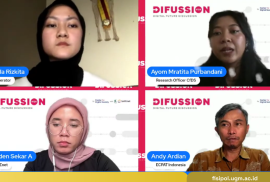
Yogyakarta, 4 July 2025 — As internet access becomes increasingly prevalent among children, ensuring a safe digital environment has emerged as an urgent priority. According to data from Statistics Indonesia (BPS) in 2024, 35.5 percent of children aged 0–4 years have accessed the internet, indicating that digital exposure now begins at a very early age. While this brings opportunities for learning and development, it also presents serious risks—including exposure to harmful content, cyberbullying, and digital exploitation.
SDGs 9: Innovation and Infrastructure
Research is not merely a process of data collection, but also a meaningful space for learning. This was evident in the fieldwork experience of students from the Faculty of Social and Political Sciences (FISIPOL) at Universitas Gadjah Mada (UGM), who joined a research team focusing on women’s empowerment and social justice across various regions in Indonesia. Through direct interaction with women from diverse social, cultural, and economic backgrounds, these young researchers not only sharpened their technical skills but also reflected deeply on their own position, privilege, and social responsibility as academics.
Seoul, June 26, 2025 — As the urgency of the climate crisis continues to intensify, the global community faces a growing obstacle: the spread of misinformation and disinformation that hampers public understanding and concrete climate action. At the prestigious 9th Climate Energy Summit held in Seoul, South Korea, Dr. Novi Kurnia, a lecturer in the Department of Communication Science at FISIPOL UGM and lead researcher at the Centre for Digital Society (CfDS) UGM, delivered a keynote address offering a critical perspective from the Global South on the rampant spread of climate-related falsehoods.
Yogyakarta, July 2, 2025 — The Faculty of Social and Political Sciences (FISIPOL) at Universitas Gadjah Mada once again demonstrated its commitment to supporting the student admission process by serving as one of the official venues for the Universitas Gadjah Mada Entrance Examination (UM UGM) Computer-Based Test (CBT) 2025. The examination took place over four days, from July 2 to 5, 2025.
As one of the designated test centers in Yogyakarta, FISIPOL UGM provided two venues—the Auditorium on the 4th Floor and the East Seminar Room—which were optimally prepared to ensure a smooth testing process. The exam was conducted in two daily sessions: the morning session from 07:30 to 11:45 WIB, and the afternoon session from 13:00 to 17:15 WIB. On Friday, the afternoon session was held from 13:45 to 17:00 WIB.
The Faculty of Social and Political Sciences (FISIPOL) at Universitas Gadjah Mada (UGM) once again demonstrated its commitment to supporting the national university admissions process by serving as one of the official venues for the 2025 UGM Entrance Examination (UM UGM) Computer-Based Test (CBT). The examination is scheduled to take place over four days, from July 2 to July 5, 2025.
As one of the designated test locations in Yogyakarta, FISIPOL UGM has prepared two exam rooms—the 4th Floor Auditorium and the East Seminar Room—with optimal arrangements to ensure the smooth and orderly execution of the test. The examination is conducted in two sessions daily: the morning session runs from 07:30 to 11:45 WIB, while the afternoon session takes place from 13:00 to 17:15 WIB. On Friday, the afternoon session starts at 13:45 and ends at 17:00 WIB.
Yogyakarta, July 1st 2025─In order to strengthen digital governance and promote cross-sector data interoperability, the Center for Digital Society (CfDS) collaborated with Jogja Smart Province (JSP) to hold a public discussion titled “The Roadmap of SPBE 2025: Strengthening Digital Governance and Data Interoperability.” The discussion features three main speakers: Perwita Sari (Policy Formulation Coordinator for SPBE Implementation, Ministry of PAN-RB), Nanang Ruswianto (Chair of the SPBE Assessment Team at UGM), and Sayuri Egaravanda (JSP Team).
Magelang, June 24, 2025 — Students of the Magister Public Administration Affirmation Program (MAP) at Universitas Gadjah Mada undertook a field trip to Magelang Regency as part of a learning process connecting theory with practical public policy implementation. The activity, held from June 23–24, involved scholarship recipients from various local government institutions across Indonesia and focused on strengthening Micro, Small, and Medium Enterprises (MSMEs) as pillars of the local economy and job creation.
Yogyakarta, June 17th 2025—A professor from UGM’s Department of Communication Science published an introductory book regarding the theory of Niklas Luhmann as an eye-opening perspective in the field of communication science. Prof. Dr. Phil. Hermin Indah Wahyuni organized a discussion with several communication science experts from Universitas Padjadjaran titled “Titik Balik: Teori Sistem dalam Ilmu Komunikasi” on Tuesday (17/6).
Niklas Luhmann is a German sociologist who discovered the systems theory. Luhmann was inspired by Talcott Parsons theory of the social system, which aims to answer the many questions that society faces in regards to social change. It is the development of this theory that is explained as the Luhmann systems theory, in which the social system is not shaped through mutual agreement, moreso through conflicting disagreement. Without difference of opinions, there won’t be interaction between social actors and therefore, a system will not be formed.
Yogyakarta, June 13th 2025—In an ever-changing world faced with many social, environmental, and economic challenges, a big question arises: What if businesses are not just profit-oriented, but also think about the impact? This question became a very intriguing introduction in the opening webinar for the 9th Batch of the C-Hub Talent Pitching, a yearly program which pushes the spirit of social entrepreneurship among youths. Bringing the theme of “Future-Fit”, this program is back again with new spirits in placing inclusivity and sustainability as the main foundation for building a brighter future. In the webinar titled “Future-Driven Entrepreneurship for a Sustainable Tomorrow”, Fisipol UGM’s Creative Hub presented two inspirational speakers, none other than Satya Dewastra B. W., founder of Ailesh, and Rika Novayanti, expert strategic communication on environment, as well as the Co-founder of Mosaic.
Dr. Mehmet Cevat Yildirim, as Associate Professor of Public Administration, explained that the global crisis has experienced its own set of dynamics from time to time along with technological advancements and climate change. For example, in 1970, there was a transition from the import sector to global manufacturing. It then developed further to global factory networks due to globalization. Now, the world has entered an era of robotic technology and the neoliberal economic structure. These changes have caused a number of disruptions in various fields, including employment. “This creates new problems for countries that depend on the development of urban areas. This is the case in Turkey, where the growth of industry outpaced the infrastructure planning process,” Mehmet stated. Gebze, one of the centers of the automotive and chemical industries that drive Turkey’s economy, is now faced with the lack of adequate infrastructure. Unprepared, the city infrastructure is increasingly under pressure, causing several social problems such as congestion, minimal public service, and high population density.
Similar things are happening in Indonesia, specifically in the city of Bekasi, West Java. Mehmet’s research has shown Bekasi as the centre of the world’s automotive industry that has grown at a rapid pace due to investments. However, the area of Bekasi itself is separated into two very unequal areas, namely the modern industrial district and the residential district. “The city infrastructure that we see in Bekasi is under pressure due to high amounts of migration, land purchase for investment and infrastructure gaps,” Mehmet explained. According to him, the economic growth experienced is not accompanied by proper access to public services and infrastructures.