
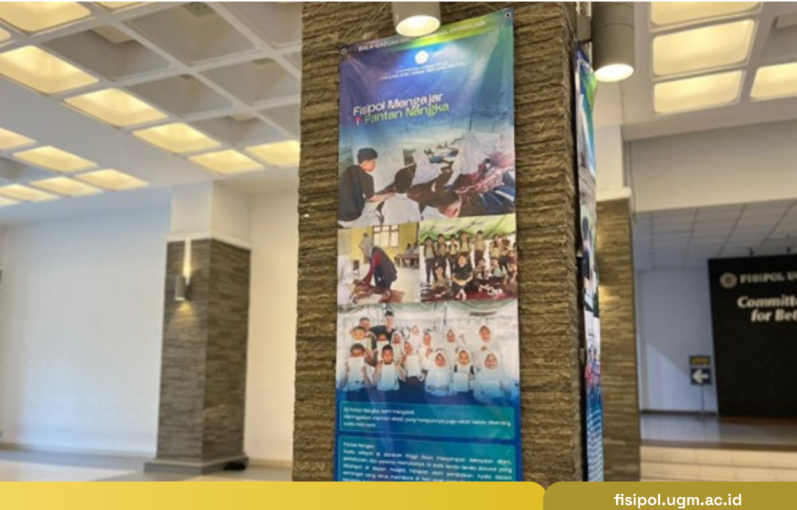
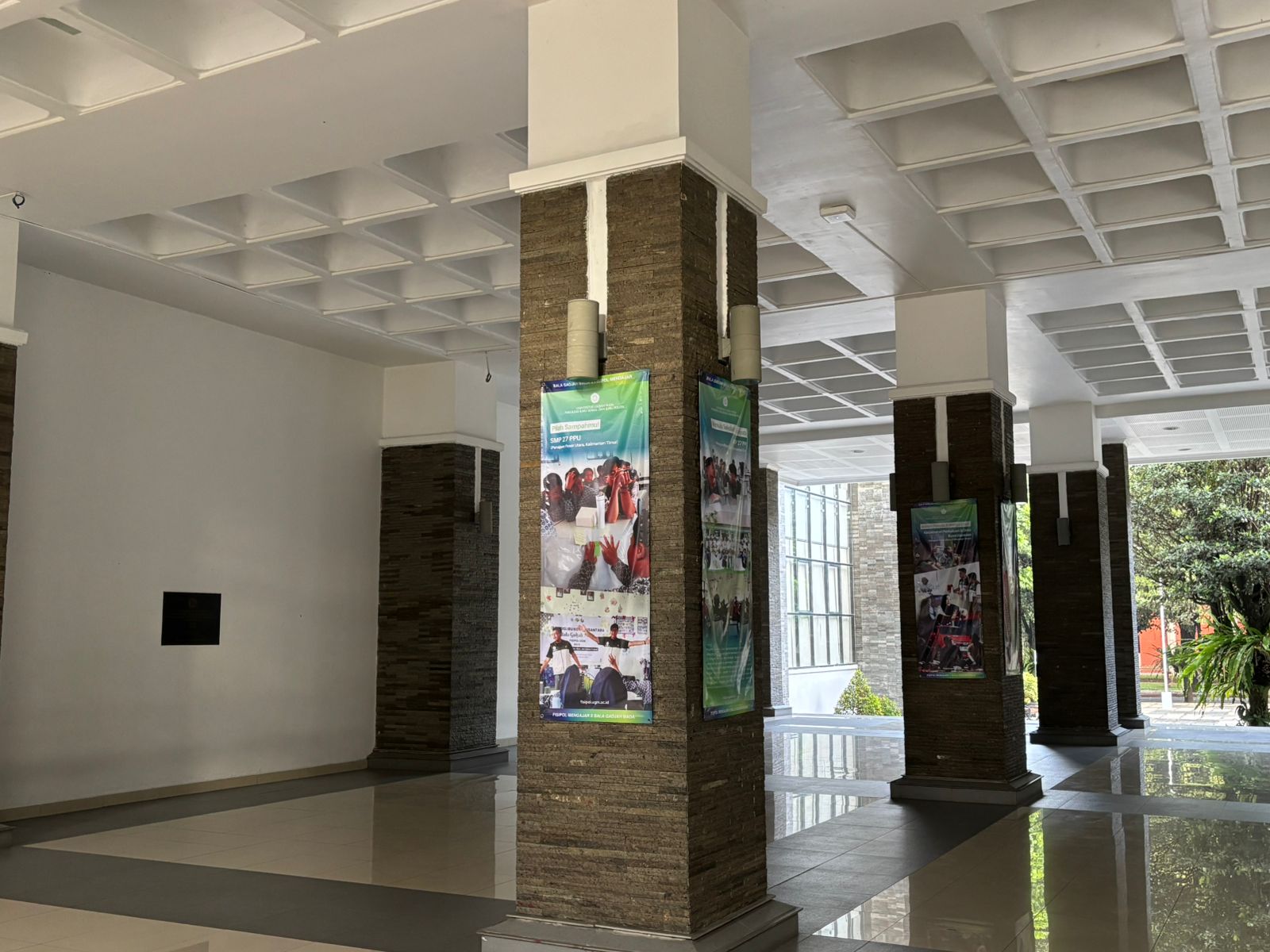
Yogyakarta, April 24, 2026 – The West Corridor (Selasar Barat) of the Faculty of Social and Political Sciences (FISIPOL) UGM has been transformed into a deeply meaningful space of reflection since Friday (24/4). This exhibition presents the track records of two community service programs, namely FISIPOL Mengajar and Bala Gadjah Mada Setrajana.
Despite being in geographically distant locations, these two programs are bound by the same dedication to fundamental issues: education and ecological sustainability. This exhibition does not merely celebrate the completion of a work program; rather, it serves as a medium to voice the actual realities on the ground that often escape media coverage.
Through the visual works on display, visitors are invited to trace the dynamics of the post-disaster Acehnese community. The photographs capture a bitter reality that from the initial phase of the crisis, throughout the volunteers’ service period, up until this exhibition was held, the condition of the community there has not fully recovered. The heavy challenges in rebuilding access and proper learning environments for survivor children are recorded very honestly in every frame, reminding the public that they still need sustainable assistance.
Meanwhile, in another corner of the exhibition, the lens shifts to focus on the Penajam Paser Utara region, which directly intersects with the IKN (Nusantara Capital City) project. Documentation from the Bala Gadjah Mada Setrajana team reveals that behind the massive development, there is an emergency issue regarding waste management that requires immediate intervention. Facing this condition, the students did not merely record the problem but also initiated a solution through the formation of the Empowered Waste Bank (Bank Sampah Berdaya) group a tactical step to foster environmental awareness that generates an economic impact for local residents.
Overall, this exhibition demonstrates how the academic community of FISIPOL UGM applies their knowledge by directly engaging with inequalities in society. The dedication to remain present in disaster-affected areas and the environmental conservation initiatives in transitional regions are tangible manifestations of the institution’s spirit. This step is expected to serve as a collective driving force to continue ensuring equal access to quality education, building resilient residential areas for citizens, and overseeing concrete actions to maintain climate and environmental sustainability.