
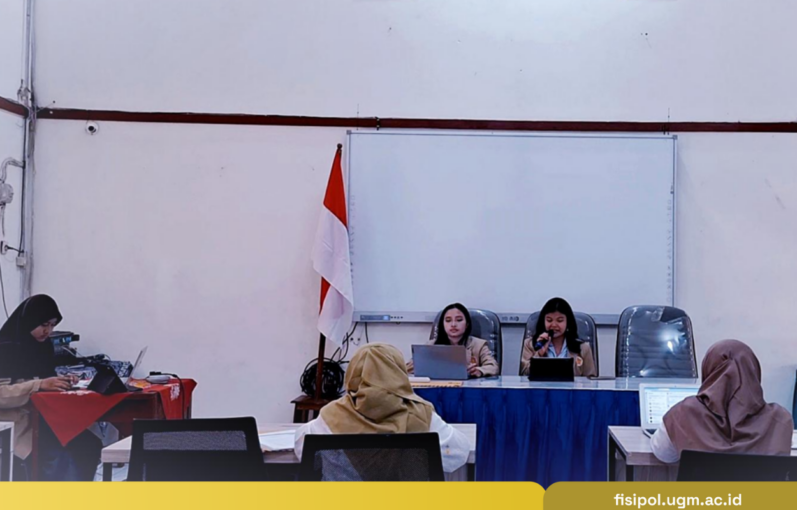
Yogyakarta, September 8, 2026—Universitas Gadjah Mada (UGM) students, participating in the Student Creativity Program for Social Sciences and Humanities Research (PKM-RSH), have formulated a preventive strategy rooted in Javanese culture to address the rise of klithih (street violence) cases in Yogyakarta. The research was conducted in the Special Region of Yogyakarta from May to September 2026.
Guided by Dr. Phil. Oki Rahadianto Sutopo, Ph.D., a lecturer from the Department of Sociology, a team of five students—Arsillia Wempin Yaurilasari (Faculty of Social and Political Sciences), Ariani Nur Wulandari (Faculty of Social and Political Sciences), Khayyahatti Maulidina Surgawi (Faculty of Psychology), Gracia Hana Ester W. K. P. (Faculty of Psychology), and Carlos Jose Prabakusuma (Faculty of Cultural Sciences)—carried out a research project titled “Clash Over Klithih: Self-Regulation Based on the Sedulur Papat Limo Pancer Philosophy as a Preventive Factor Against the Klithih Phenomenon in Yogyakarta.”

This research was motivated by concerns regarding klithih incidents in the Special Region of Yogyakarta (DIY) that randomly target members of the public. Furthermore, the perpetrators of klithih are predominantly adolescents. Data from the DIY Police for 2025 indicate that 155 out of a total of 291 street crime perpetrators were adolescents under the age of 18 (Suhendra, 2025). Yet, this age range represents a critical phase in identity formation. When this phase lacks adaptive guidance from adults, it can lead to an impulsive mindset among adolescents.
“Fundamentally, adolescents still require guidance from adults, particularly their parents. Adolescence is a crucial phase for identity formation. When there are gaps in this process, adolescents become vulnerable to making decisions that lead to acts of violence. If this is not addressed early on through interventions focused on character education and self-regulation, the pattern may persist into adulthood. Such violence can even escalate into more dangerous criminal behavior,” stated Arsillia, a member of the Clash Over Klithih team.
Based on the research findings, the Clash Over Klithih team identified that klithih stems from complex factors, including indications of poor self-control. This finding aligns with the concept of pancer within the Sedulur Papat Limo Pancer philosophy and Steinberg’s Dual Systems Theory. According to developmental psychology, adolescents are often unable to inhibit impulsive urges because the prefrontal cortex—responsible for emotional control and planning—has not yet fully matured. These internal drives can be interpreted through the Sedulur Papat Limo Pancer framework, which suggests that klithih behavior is an expression of various internal impulses, such as aggression, sensation-seeking, and self-actualization. These expressions are triggered by the interplay of internal and external factors during adolescent decision-making, resulting in problematic risk-taking behavior.
To bridge the imbalance between emotional control and impulsive urges, self-regulation is essential. The process of developing self-regulation is optimized when accompanied by the instilling of moral values. The Serat Wedhatama—specifically Volume III (Serat Wedhatama Kawedhar) by Wiryapanitra—offers insights into moral values, including the concept of Sedulur Papat Limo Pancer. The “Clash Over Klithih” project found that the values within the Serat Wedhatama have the potential to strengthen adolescent self-regulation. The text contains patterns and values regarding self-cultivation—such as rasa (inner feeling/sensitivity), eling lan waspada (mindfulness and vigilance), tepa sarira (empathy/consideration for others), and srawung (social interaction)—that could serve as effective components in interventions for adolescents.
Based on these findings, the “Clash Over Klithih” team proposes several implementation strategies to support the application of these values. The first strategy emphasizes the need for adaptive, locally grounded interventions that take adolescent developmental psychology into account. Next, the team advocates for internalizing values through character education and Guidance and Counseling (BK) services rooted in the principle of momong—a form of guidance characterized by sih (loving care) that simultaneously provides direction. Furthermore, adolescents require spaces for self-expression where they can channel their emotions adaptively. Finally, interventions require multi-sector collaboration—involving the government, academia, community groups, and other stakeholders—to ensure effectiveness and avoid policy overlap.
This research yields three outputs: a scholarly article, a policy brief, and a draft educational module. The scholarly article is intended to serve as an academic reference that enriches the literature on integrating Javanese culture and adolescent psychology in character development. The policy brief aims to provide input for policymakers formulating holistic policies based on Javanese culture and adolescent psychology, particularly to enhance cross-sector coordination and strengthen the role of educators in guiding adolescents. The educational module is designed to outline the implementation of interventions grounded in Javanese culture and adolescent psychology, thereby supporting constructive character development among adolescents.