
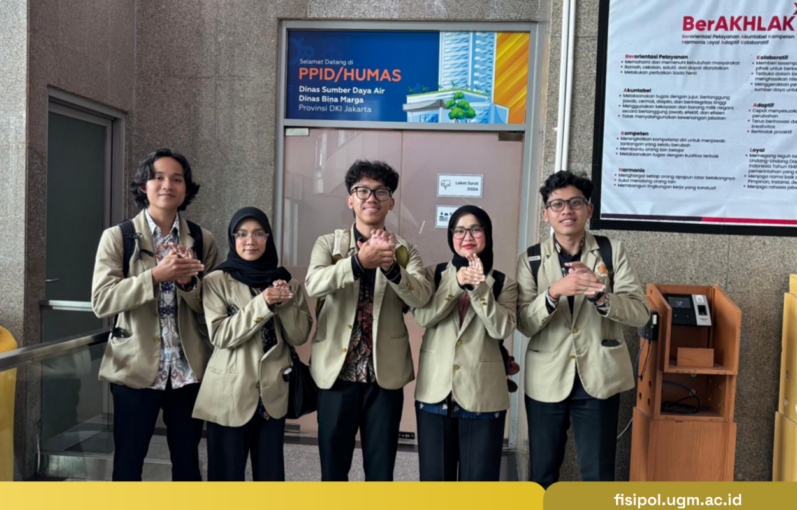
Yogyakarta, September 2, 2026—Five Universitas Gadjah Mada (UGM) students, forming the Student Creativity Program for Social Sciences and Humanities Research (PKM-RSH) team, are developing a sociotechnical approach to address the threat of tidal flooding in the Muara Baru area. Two of the students are from the UGM Faculty of Social and Political Sciences (FISIPOL): Muhammad Aditya Nugroho Sofyan and Muhammad Aditya Ibnu Salim. The other three hail from different UGM faculties: Nurul Aliyyah (Faculty of Law), Khansa Najla Athaya (Faculty of Engineering), and Aryo Wicaksono (Faculty of Geography).
Nur Azizah, M.Sc., a lecturer in the Department of Politics and Government at FISIPOL UGM, supervises the five students. They are conducting research titled “PALANG LAUT: Utilizing Urban Regime Theory to Formulate a Sociotechnical Approach Model for Mitigating Tidal Flooding in the Muara Baru Area.”
The research stems from the team’s concern regarding the increasingly tangible threat of tidal flooding in Jakarta’s coastal areas, particularly Muara Baru. Rising sea levels, coupled with land subsidence, have made the area increasingly vulnerable to tidal floods. This issue is a major concern because Muara Baru is not merely a residential area; it also hosts strategic marine-based economic activities.
“Tidal flooding isn’t just about residents’ homes getting flooded. It often disrupts economic activities and impacts daily routines as well,” said Lia, a member of the Palang Laut team.
These concerns are driven by the substantial impact tidal flooding can have on the social and economic activities taking place in Muara Baru. The area is home to the Nizam Zachman Oceanic Fishing Port—Indonesia’s largest fishing port—and the Muara Baru Fish Market, which records a daily turnover of approximately IDR 8 to 10 billion.
Based on research involving interviews and data collection in the Muara Baru area, the Palang Laut team found that tidal flood mitigation efforts remain ineffective. Notably, 89% of respondents have had to independently raise the elevation of their homes to cope with tidal flooding.
Beyond community-level issues, the team identified several obstacles in the governance of tidal flood mitigation. These range from overlapping institutional authorities and policies that remain spatially fragmented and unintegrated, to bureaucratic processes slowed by sectoral ego.
The findings reveal that tidal flooding cannot be viewed solely as an infrastructure issue; social and institutional factors—particularly the coordination among various stakeholders managing the coastal area—also require attention.
These findings prompted the Palang Laut team to develop a socio-technical approach as an alternative strategy for mitigating tidal floods in Muara Baru. This approach integrates technical aspects with social and institutional dimensions, as well as ecosystem carrying capacity.
Through this approach, the Palang Laut team proposes several solutions, including the development of green open spaces and community-led mangrove planting rooted in local wisdom. These efforts are intended to complement coastal protection infrastructure while strengthening the community’s role in safeguarding their living environment.
The research has produced a scientific article, a policy brief, and a draft master plan for green open spaces in the Muara Baru area. This master plan outlines the planning and development of green open spaces designed to support tidal flood mitigation efforts while simultaneously providing areas that benefit the local community. Meanwhile, the policy brief is expected to serve as input for policymakers in evaluating and formulating more integrated policies to address tidal flooding, particularly by strengthening inter-agency coordination and enhancing community involvement in coastal area management.
Kirim masukan