
Yogyakarta, August 14, 2026—Amid the increasingly massive onslaught of modern retail development, the local community of Kampung Batik Kauman in Solo continues to strive to preserve their batik businesses. The Gentriset Team from Universitas Gadjah Mada, through the Student Creativity Program in Social and Humanities Research (PKM-RSH), investigated the adaptation strategies employed by local business owners in this area, known as a cultural village.
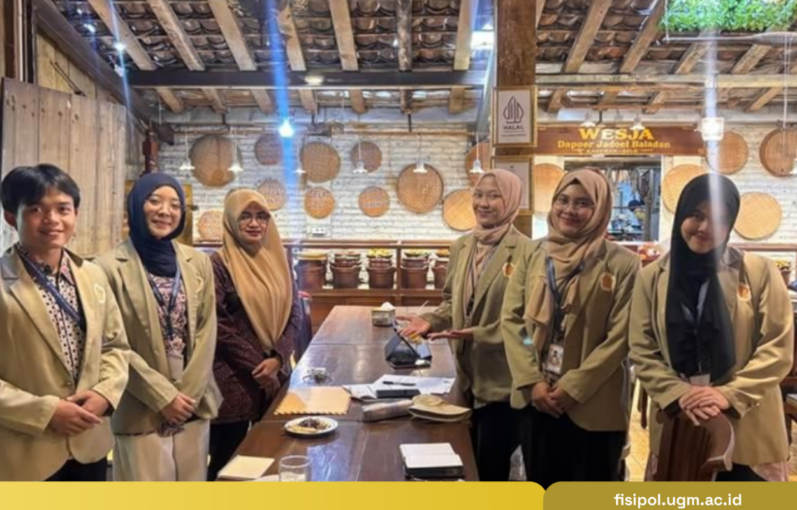
The Gentriset team, through the Student Creativity Program in Social and Humanities Research (PKM-RSH), studied the strategies employed by the local community of Kampung Batik Kauman in Solo to survive amid the rise of modern retail. The team was led by Hanel Aulia Afro (B.A. in Sociology), along with Nasywa Izzati Firdaus (B.A. in Politics and Government), Elang Gading Permana (B.A. in Geographic Information Systems), Laras Dwi Anggraeny (B.A. in Politics and Government), and Nasywa Adinda Ibrahim (B.A. in Cultural Anthropology). They were supervised by Odam A. Artosa, M.A., a Sociology lecturer at the Faculty of Social and Political Sciences (FISIPOL) at UGM.
“This research initially stemmed from our interest in a journal article discussing retail gentrification in Seoul, South Korea. We noticed similarities in the patterns observed there and those occurring in Indonesia, particularly in Kampung Batik Kauman, Solo. Behind its charm as a cultural village, there is another side that few people realize—a revitalization paradox that has the potential to trigger retail gentrification. From there, we decided to delve deeper into why this was happening,” said Hanel Aulia, chair of the Gentriset Team at UGM’s PKM-RSH.
Kampung Batik Kauman, located in the heart of Surakarta, is indeed bustling with tourists. However, behind the tourist hustle and bustle, the number of batik shops has actually decreased, not increased. Throughout 2024, the number of batik retail shops shrank from 30 to 26, while culinary businesses in the area have quadrupled over the past five years.
Gunawan Setiawan, chair of the Kauman Batik Tourism Village Association, also noted that the surge in tourists has not been accompanied by an increase in purchasing power. Most of them come to take photos, not to buy batik.
The team refers to this phenomenon as the “cultural revitalization paradox.” Areas revitalized to improve residents’ well-being actually risk displacing them. “Gentrification usually involves land prices or home evictions. We see that in Kauman, it’s a bit different—it’s not the residents who are being evicted, but the commercial spaces, which indicate a change in the function of the area. This is what we call the paradox,” said Nasywa Izzati.
Currently, the team has completed its analysis of the gentrification process and the relationships among actors, while the study on local communities’ adaptation strategies is still underway toward the final report. Moving forward, these findings will be presented in a scientific article targeted for publication in an accredited journal, a social mapping project that will document shifts in the number of retail businesses in Kampung Batik Kauman, Solo, and a policy brief specifically addressed to the Surakarta City Department of Public Works and Spatial Planning, the Department of Culture and Tourism, and the Department of Housing, Settlements, and Land Affairs.
The team hopes that their research, which examines the issues in Kampung Batik Kauman, Solo, will not only advance to the National Student Scientific Week (PIMNAS) but also make a tangible contribution to policies protecting the local economy in Kauman.