
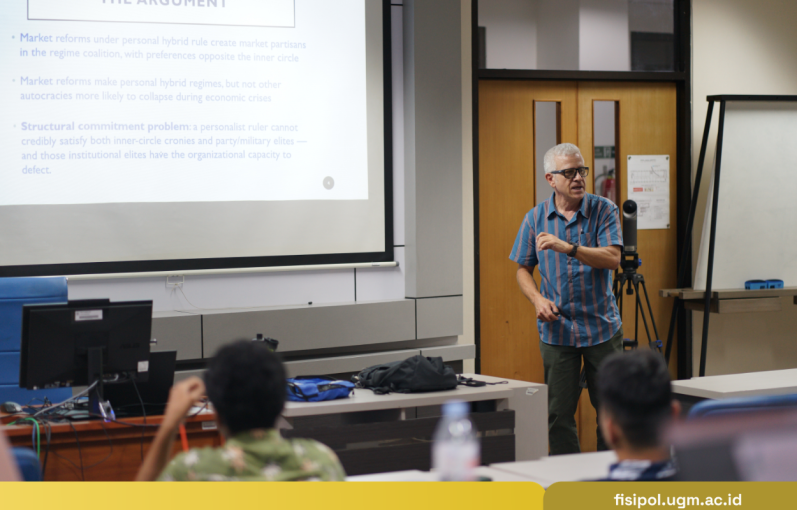
Yogyakarta, 24 June 2026─The Faculty of Social and Political Sciences at Gadjah Mada University (FISIPOL UGM) hosted a public lecture titled “Tinpots and Technocrats? Market Reforms and the Politics of Personal Rule.”
The event featured Professor Benjamin Smith from the University of Florida as the keynote speaker. Professor Smith is an expert in comparative politics and political economy, known for his research on natural resource wealth, ethnic conflict, and regimes and regime change in developing countries.
In his presentation, Smith defined two key terms in the title of his research. He explained that “tinpots” refer to personalist dictators who act based on their personal whims, while “technocrats” are economic policy specialists who advocate for decisions based on expertise. He also highlighted that Suharto’s downfall in May 1998 was not solely triggered by mass demonstrations, but rather by the withdrawal of support from members of his own governing coalition—a fact that forms the central focus of the research project he is conducting with his colleagues.
Smith explained that their research combines qualitative methods—tracking Indonesia’s historical trajectory from 1978 to 1999—with cross-national quantitative methods that test the findings from the Indonesian case against all authoritarian regimes worldwide between 1971 and 2010. He carried out this project in collaboration with Indonesian researcher Yudhi Zahrapadi.
Based on this statistical research, Smith presented a key finding that refutes the common assumption that economic reforms always strengthen the stability of authoritarian regimes. Instead, he found that a combination of economic crisis, economic openness, and a hybrid personal authoritarian regime creates the greatest vulnerability. “In other words, hybrid authoritarian regimes that have implemented economic reforms are more vulnerable to economic crises than other types of authoritarian regimes. “That is the general conclusion we reached in this study,” he emphasized.
Professor Smith’s presence is expected to spark critical discussion and enrich participants’ understanding of the complexities of the relationship between economic policy and power structures in various countries.