
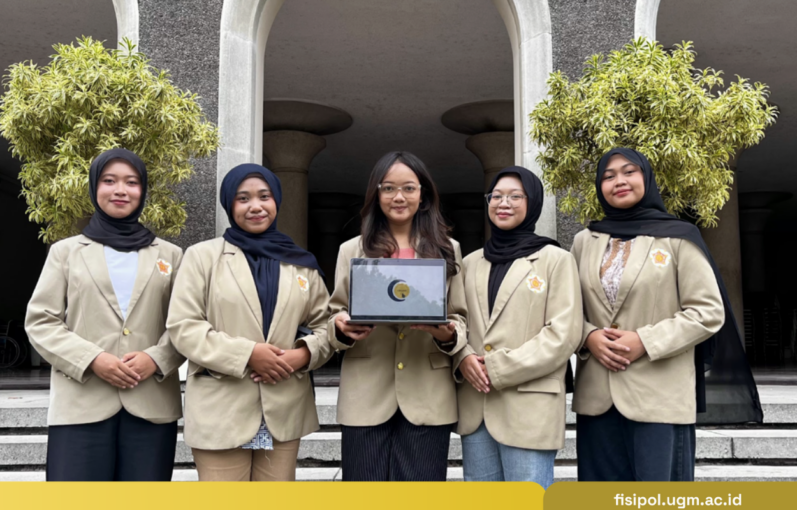
Yogyakarta, September 10, 2026—Three students from the Faculty of Social and Political Sciences (FISIPOL) Universitas Gadjah Mada (UGM)—Widyastri Prabaningrum (Communication Sciences, 2024), Nayla Devira Cahyani (Communication Sciences, 2024), and Upik Maulia (Social Development and Welfare, 2023)—along with Rizki Laidha Putri (Law, 2024) and Dini Rindang Ekarini (Economics, 2023), are examining clickbait practices in affiliate content on the X platform under the guidance of Mashita Phitaloka Fandia Purwaningtyas, S.I.P., M.A. This study is being conducted through the Student Creativity Program for Social Sciences and Humanities Research (PKM-RSH). The research is titled “The Price of a Click: Clickbait Practices in Affiliate Content on the X App as a Consequence of the Attention Economy within the Gig Economy.”
The research idea stemmed from the team’s experience encountering threads on X that grabbed their attention by discussing current events, only to reveal—upon scrolling down—that they contained affiliate links for e-commerce products. This experience prompted the team to investigate further how clickbait-based affiliate content practices are executed and how audiences respond to them. The findings are analyzed through the lens of Vincent Mosco’s (2009) Political Economy of Communication, specifically emphasizing the concept of commodification. In the digital realm, user attention is no longer merely a component of social media activity; it acquires economic value when channeled into clicks that can generate commissions for the affiliate marketer. In this context, clickbait serves as a strategy to capture user attention amidst the fierce competition for digital content.
“Through this research, we aim to examine and understand how these practices are carried out. By doing so, we hope to identify measures that can be taken to establish effective platform governance and foster a healthy digital ecosystem,” explained Widyastri Prabaningrum, the team leader. “We are concerned that if this practice continues unchecked, the digital space—which ought to be a venue for sharing credible information—will instead degrade, becoming cluttered with content that exploits audience curiosity for commercial gain,” added Widya.
Interestingly, the study reveals that capturing attention does not always equate to generating clicks. Survey results from 385 respondents indicate that the majority of the audience finds clickbait-style affiliate content annoying, often reacting with irritation. Audiences are also less inclined to click on affiliate links when the content relies on clickbait tactics. Conversely, affiliate content that avoids clickbait is more effective at encouraging audiences to click the shared links.
In addition to the survey, the study incorporates content analysis and interviews with relevant institutional stakeholders to examine clickbait-based affiliate content practices and platform governance. By integrating audience perspectives with governance considerations, the team aims to view affiliate practices not merely as a digital marketing strategy, but as part of the broader dynamics of the gig and attention economies.
The team hopes this study will foster a more critical perspective on the evolution of digital work while raising user awareness regarding affiliate content. Furthermore, the research aims to encourage the development of platform governance frameworks that protect audiences—as potential consumers—amid the rapid growth of the digital economy.
As part of this initiative, the team is sharing research findings and educational content on the subject via the Instagram account @pkmrshugm.clickbait. Additionally, the study seeks to promote platform governance that protects both affiliates (as digital workers) and audiences (as potential consumers) within the digital economy. This research aligns with SDG 8 (Decent Work and Economic Growth) and SDG 12 (Responsible Consumption and Production).