
Yogyakarta, September 8, 2026—Sharing details of children’s daily lives on TikTok has become an increasingly widespread phenomenon among parents. In fact, 82% of parents have engaged in this practice of “sharenting” (Stephenson et al., 2024). However, the sharenting content proliferating on TikTok today serves not merely as documentation but is also monetized to generate profit. This monetization of sharenting content can potentially lead to forms of child exploitation on social media.
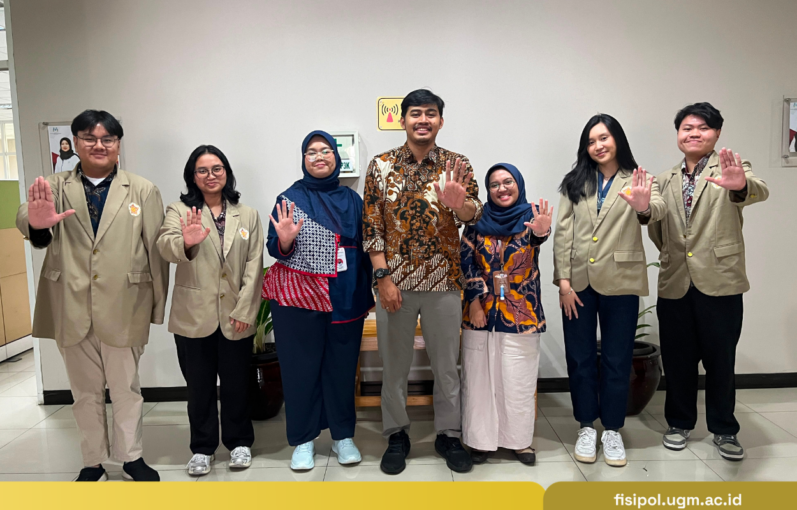
These concerns prompted five students from Universitas Gadjah Mada—Phedra Annabelle (Faculty of Social and Political Sciences), Laurensius Yuniarta (Faculty of Social and Political Sciences), Shallom Gracia (Faculty of Psychology), Giasinta Anra (Faculty of Law), and Leonardo (Faculty of Economics and Business)—to conduct a study titled “Childhood in the Digital Showcase: Digital Exploitation through the Monetization of Child-Focused Content in the Sharenting Era.” The five students formed the “Teman Tumbuh” team under the Student Creativity Program for Social Sciences and Humanities Research (PKM-RSH), with guidance from Communication Studies lecturer Mashita Phitaloka Fandia Purwaningtyas, S.I.P., M.A.
The Teman Tumbuh team conducted their research by analyzing sharenting content found on TikTok. Additionally, they interviewed experts representing three distinct roles: the Ministry of Women Empowerment and Child Protection (Kemen PPPA) as the government agency and regulator; the Yogyakarta City Regional Child Protection Commission (KPAID) as the non-structural body handling child protection cases; and the Semai Jiwa Amini Foundation (Sejiwa Foundation) as a non-governmental organization. Through this research, the Teman Tumbuh team discovered that the narratives constructed in “sharenting” content position children as integral to promotional strategies—whether as product users or sources of testimonials. Aspects of a child’s daily life, physical condition, achievements, and even their expressions and emotions are packaged to support stories and product claims. Some content even reveals that children are directed on how to behave in front of the camera to suit the content’s requirements. Meanwhile, the forms of exploitation most frequently encountered in sharenting content are financial exploitation and the exploitation of children’s data. Financial exploitation is evident when children are involved in creating content that generates economic profit. Conversely, data exploitation is seen in the vast amount of personal information displayed—such as the child’s face, name, routines, personal circumstances, location, and private activities.
To address these issues, the Teman Tumbuh team identified a need to raise awareness among parents and TikTok users by improving digital literacy. These efforts must go hand-in-hand with stronger regulations, collaboration among various stakeholders, and the refinement of protection systems on digital platforms.
“Child exploitation occurring through sharenting content often goes unnoticed because it is perceived merely as sharing ordinary family activities. This is why we believe it is crucial to build awareness—not only among parents but also among TikTok users—so they can recognize the risks of exploitation in sharenting content and establish a system of community oversight,” stated Phedra Annabelle, leader of the Teman Tumbuh team.
This research aims to drive societal change and serve as a basis for advocacy among policymakers. Consequently, in addition to producing academic articles, progress reports, and final reports, the Teman Tumbuh team has developed policy briefs and social campaigns, and maintains an active social media presence. The research team took these steps to ensure that their findings do not remain confined to academic circles but are understood and utilized by the public—particularly parents and social media users—while also providing policymakers with insights to strengthen child protection in the digital space. “We want this research to go beyond mere text or data on paper. We hope our findings truly reach the public, raising awareness among parents and social media users while driving a shift in how we view and protect children in the digital space,” explained Phedra Annabelle.
Ultimately, sharing moments of a child’s growth and development on social media is not inherently wrong. However, when a child’s face, stories, activities, and private life become part of a strategy to generate engagement and profit, it is crucial to ask: to what extent is the child truly protected within that content? For the Teman Tumbuh team, this is the question that must remain at the forefront of the conversation, ensuring that the digital realm becomes not just a place for sharing stories, but also a safe space for children to grow.
Reference
Stephenson, S., Page, C.N., Wei, M., Kapadia, A. dan Roesner, F. (2024) ‘Sharenting on TikTok: Exploring Parental Sharing Behaviors and the Discourse Around Children’s Online Privacy, CHI’ 24: Proceedings of the 2024 CHI Conference on Human Factors in Computing Systems. Honolulu, 11-16 Mei. New York: Association for Computing Machinery, hlm. 1–17.