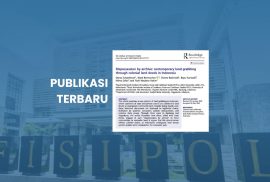
Bayu Dardias Kurniadi, lecturer at the Department of Politics and Government (DPP), Faculty of Social and Political Sciences (FISIPOL) Universitas Gadjah Mada, has achieved another academic milestone through his latest publication in the internationally renowned journal Journal of Peasant Studies (Routledge). The article, titled “Dispossession by Archive: Contemporary Land Grabbing Through Colonial Land Deeds in Indonesia,” was co-authored with Diana Suhardiman, Ward Berenschot, Dianto Bachriadi, Hilma Safitri, and Rizki Maulana Hakim.
SDGs 15: Life on Land
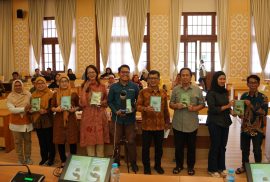
Yogyakarta, July 17, 2025 — Universitas Gadjah Mada (UGM), through the Faculty of Social and Political Sciences (FISIPOL), officially held the soft launching of the book “Community Empowerment and Sustainable Partnership: Experiences and Reflections of Working with Communities in the Special Purpose Forest Area (KHDTK) Blora–Ngawi” on Thursday afternoon at Multimedia Room 1, UGM Rectorate Building. This book serves as a reflective and scholarly documentation of UGM’s long journey in community-based forest management since 2016.
Are you passionate about writing and interested in issues related to digital transformation? We invite you to contribute your ideas and submit your articles to be published on the Megashift FISIPOL UGM website! ☺️
Important Notes:
Detailed submission guidelines and suggested subtopics are clearly outlined in the official poster.
This call for articles is open year-round, with no submission deadline.
Articles should be no longer than 1,000 words, including references.
Submissions must include citations from publications, journals, or books written by FISIPOL UGM lecturers or researchers.
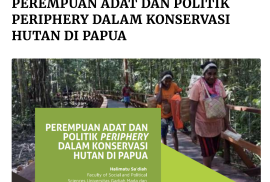
MEGASHIFT, a publication initiative by the Faculty of Social and Political Sciences (FISIPOL) Universitas Gadjah Mada, has released its latest feature article highlighting urgent socio-political issues in Indonesia. Titled “Indigenous Women and the Politics of Periphery in Forest Conservation in Papua”, the article by Halimatu Sa’diah sheds light on the structural injustices faced by Indigenous Papuan women in their struggle to protect ancestral forests.
The article critically explores how Indigenous women—often positioned at the margins of state power—play a crucial role in forest conservation through their deep-rooted local knowledge. Through the lens of periphery politics, Sa’diah analyzes how centralized governance in Java, industrial expansion, and the inadequate legal protection for Indigenous communities have systematically marginalized women, both economically and socially.
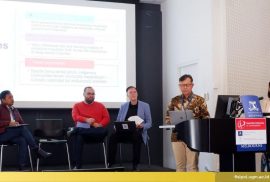
Melbourne, 9 July 2025 — The Faculty of Social and Political Sciences (FISIPOL) at Universitas Gadjah Mada (UGM), in partnership with the University of Melbourne, successfully held the 5th Australia-Indonesia in Conversation (AIC) 2025. This year’s forum took place at the University of Melbourne, Australia, following its previous iteration hosted at FISIPOL UGM.
Carrying the theme “Bridging Development, Representation, and Indigenous Knowledge: Learning from Australia and Indonesia”, the forum brought together scholars and representatives of Indigenous communities to discuss critical issues at the intersection of social justice, sustainable development, and recognition of local knowledge.
Yogyakarta, July 2025 — The Faculty of Social and Political Sciences (FISIPOL) at Universitas Gadjah Mada is undergoing a major renovation of Digilib Cafe, a creative space that has been part of the campus ecosystem since its establishment in 2017. The renovation, which began at the end of 2024, has now reached its halfway point, marked by the completion of the new front façade as the first step in the comprehensive transformation of the area.
The next phase will focus on interior design, landscaping of green spaces, and finalizing the cafe’s management system, which is expected to become a new gathering point for students. The revitalization of Digilib Cafe is intended not only as a supporting facility but also as a living space that fosters an inclusive and collaborative academic atmosphere.
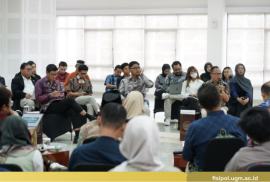
Yogyakarta, June 19th 2025 – Bulaksumur Roundtable Forum (BRF) was held again through The Clinics series which this year focused on the theme “Opportunities for Zakat, Infaq, Sadaqah, and Waqf (ZISWAF) to Build Participative Climate Finance in Indonesia”. Located at the 4th Floor Auditorium of FISIPOL UGM, this forum became a forum for cross-sector discussions to explore the potential of social funds as an instrument of inclusive and sustainable climate crisis financing. The forum presented a variety of speakers from philanthropic institutions, Islamic finance, to government agencies. Some of them were Syamsul Ardiansyah (Senior Officer of Strategic Alliance Dompet Dhuafa), Dede Haris Sumarno (Commissioner of Supervision and Governance of the Indonesian Waqf Board), and Nur Fadilah (ESG Operation and Communication Head of Bank Syariah Indonesia). In addition, the forum also involved academics and climate policy experts to enrich perspectives.
Yogyakarta, June 13th 2025—In an ever-changing world faced with many social, environmental, and economic challenges, a big question arises: What if businesses are not just profit-oriented, but also think about the impact? This question became a very intriguing introduction in the opening webinar for the 9th Batch of the C-Hub Talent Pitching, a yearly program which pushes the spirit of social entrepreneurship among youths. Bringing the theme of “Future-Fit”, this program is back again with new spirits in placing inclusivity and sustainability as the main foundation for building a brighter future. In the webinar titled “Future-Driven Entrepreneurship for a Sustainable Tomorrow”, Fisipol UGM’s Creative Hub presented two inspirational speakers, none other than Satya Dewastra B. W., founder of Ailesh, and Rika Novayanti, expert strategic communication on environment, as well as the Co-founder of Mosaic.
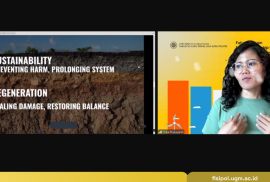
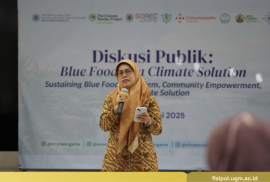
Yogyakarta, June 4th 2025 – Indonesia with its natural wealth has biological resource potential that has not been fully maximized. As an archipelago, the marine sector has long been one of the export commodities that support the country’s economy. However, on the other hand, the level of fish consumption and the welfare of fishermen have not been evenly distributed. The Faculty of Social and Political Sciences (Fisipol) of Universitas Gadjah Mada presented the discussion “Blue Food as Climate Session: Sustaining Blue Food Ecosystem, Community Empowerment, and Climate Solution” on Wednesday (4/6).
Yogyakarta, 21st of March, 2025—UGM’s Faculty of Social and Political Science supports the government efforts at carrying out a nation-wide energy transition scheme towards clean energy. Through intense cooperation with the Ministry of Energy and Mineral Resources of the Republic of Indonesia and the British Embassy in Jakarta, the MENTARI Initiation was organized on Friday (21/3) at Fisipol UGM.
Indonesia has strengthened its commitment towards Zero Emission by updating its National Energy Policy. It is stated that in 2023, as much as 23 percent of the total primary energy supply comes from sustainable energy.In the year 2050, it is targeted to be as high as 31 percent. Unfortunately, the progress towards the development of clean energy for Indonesia’s primary energy supply is stagnant, stuck at somewhere around 12 percent. This urgency requires various parties to collaborate with each other and create breakthrough innovations, so that it can endorse the utilization of clean renewable energy that is both stable and capable to accommodate the energy needs of the people.
Nurhadi, S.Sos., M.Si., Ph.D., as Vice Dean of Finance, Asset, and Human Resources Affairs of Fisipol UGM, mentioned that climate change has become one of the research umbrella for the faculty that oversees various important agendas. “Everywhere we go we can feel clean rooms, or clean air. However, where does it all come from? As a country, our energy still relies on coal. Fulfilling clean energy becomes a challenge towards resource exploitation to be controlled,” Nurhadi mentioned.