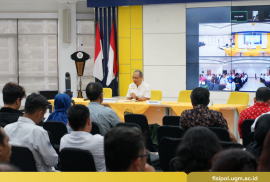
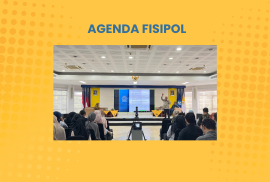
Yogyakarta, March 4, 2026 ─ The Youth Studies Centre (YouSure) at FISIPOL UGM, in collaboration with the Youth, Human Capital, & Future of Work (YHCFW) Research Group from the Population Research Center of BRIN, held a virtual book discussion on Wednesday (4/3). The event, titled Reading Group “Reboan” #141 “Introduction to Youth Perspectives: Transition, Culture, and Social Generations” (Pengantar Perspektif Kepemudaan: Transisi, Budaya dan Generasi Sosial) by Oki Rahadianto Sutopo and Elok Santi Jesica.
SDGs 8: Decent Work and Economic Growth
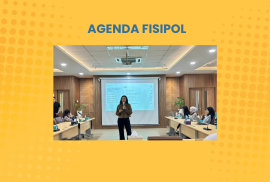
Jakarta, February 3, 2026—The use of artificial intelligence (AI) in online motorcycle taxi platforms has become a system that actively regulates, assesses, and disciplines drivers. Amidst the lack of algorithmic transparency and weak legal protection for platform workers, the Center for Digital Society (CfDS) of Universitas Gadjah Mada (UGM) and the Pulitzer Center held an offline workshop at the Faculty of Social and Political Sciences (FISIPOL) of Universitas Gadjah Mada (UGM) Jakarta Campus on Tuesday (February 3). The workshop, titled “Strengthening the Role of Advocates in Addressing Algorithmic Inequality in Online Motorcycle Taxi Platforms in Indonesia,” aimed to bridge empirical research findings and investigative reporting with legal practice by strengthening the capacity of advocates and digital rights advocates to understand, critique, and challenge the algorithmic systems that shape working conditions in the platform economy. This event brought together academics, researchers, representatives from taxi and motorcycle taxi driver associations, and legal practitioners to discuss litigation pathways, regulatory gaps, and data-driven advocacy strategies.
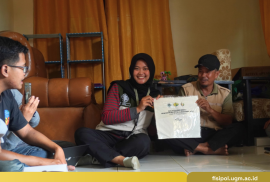
Yogyakarta, January 23, 2026—As an effort to encourage socio-economic empowerment of residents in the implementation of the Tri Dharma of Higher Education, the Faculty of Social and Political Sciences (FISIPOL) of Universitas Gadjah Mada (UGM), through the Department of Public Policy and Management (DPPM), has again deployed a community service team to Karanganom Hamlet, Sitimulyo Village, Piyungan District, Bantul Regency. For this activity, the DPPM Team partnered with the Ngudi Hasil Women’s Farmers Group (KWT) in a collaborative initiative involving lecturers and students from various levels, from Bachelor’s (S1), Master’s (S2), to Doctoral (S3). This academic synergy aims to provide comprehensive and sustainable support to the partner community.
Yulida Pangastuti, a lecturer in the Department of Sociology at the Faculty of Social and Political Sciences, Universitas Gadjah Mada, has published an international journal article titled “The Micropolitics of Care in Indonesia’s Neoliberal Universities” in Asian Studies Review.
The study explores practices of care within Indonesian higher education amid the rise of neoliberal governance, which prioritizes performance, productivity, and measurable outputs. Using a feminist perspective and qualitative methods, it highlights how empathy, attention, and care work among academics are often marginalized despite their crucial role in sustaining healthy academic environments.
Yogyakarta, 2 October 2025–The Faculty of Social and Political Sciences, Universitas Gadjah Mada (FISIPOL UGM) held a workshop entitled “Contesting Hegemony: Labor, Ideology, and the Limits of Resistance in Post-Authoritarian Indonesia” in the FISIPOL UGM’s 4th floor auditorium. The event featured four speakers: Vedi Hadiz (University of Melbourne), Hari Nugroho (Universitas Indonesia), Diatyaka Yasih (Universitas Indonesia), and Muhtar Habibi (Universitas Gadjah Mada). The discussion explored how power, ideology, and the working class interact in Indonesia’s post-New Order political and economic system, as well as the extent to which community survival strategies can develop into forms of resistance against hegemonic domination.
Yogyakarta, September 25, 2025—The Center for Digital Society (CfDS) of Universitas Gadjah Mada collaborated with the University of Oxford and Worker Exchange in organizing Difusion #127 titled “Algorithms at the Wheel: Global Perspectives on Ride-Hailing Work”. This discussion brought together Reuben Binns (University of Oxford), James Farrar (Worker Exchange), Ayom Mratita Purbandani (CfDS UGM), as well as Suci Lestari Yuana (Universitas Gadjah Mada).
This public forum highlighted how the algorithm manages and controls the workload of ride-hailing gig workers globally. This forum delved upon whether or not the artificial intelligence based-system can actually produce efficiency, or make gig workers more vulnerable. Through a research report titled “Precarity by Design: AI, Labor Discipline, and the Welfare of Ride-hailing Drivers in Jakarta and Gunungkidul”, researchers at CfDS found out that the aspects of opacity in the systems of AI is not just a mere coincidence, but a calculated approach in supporting the interest of the platform. This algorithm works by exploiting the flexibility of gig workers, where drivers need to work in order to be visible in the system.
The Soenario Kolopaking Team from the Department of Sociology, Faculty of Social and Political Sciences (FISIPOL), Universitas Gadjah Mada (UGM) has won first place in the National Student Scientific Article Competition at the Sociology Competition of Unesa (SOCIUS) 2025, organized by Universitas Negeri Surabaya (UNESA). The competition ran from June 10 to August 3, 2025, and was participated in by eight universities from across Indonesia.
The Soenario Kolopaking Team consists of Nurima Setianingrum and Afkaar Nabil Falah. Under the guidance of Gregorius Ragil Wibawanto, M.A., the team successfully presented their scientific paper titled “The Public Between the State and the Market: The Struggle of Female Online Ojek Drivers in Layered and Persistent Vulnerability.”
Yogyakarta, 9 September 2025 – The Center for Digital Society (CfDS) at the Faculty of Social and Political Sciences (FISIPOL) Universitas Gadjah Mada celebrated its tenth anniversary under the theme “A New Era to Rethink Digital.” The celebration also marked the launch of the 2025 Digital Intelligence Course (MKKD), which carries the topic “Building a Human-Centered and Inclusive Digital Ecosystem.”
Since its establishment ten years ago, CfDS has consistently empowered communities through research and advocacy in digital transformation. One of its flagship initiatives is MKKD, a free digital literacy class initiated in collaboration with the Ministry of Communication and Digital Affairs (Komdigi) in 2020. To date, MKKD has reached more than 40,000 participants and features instructors from across sectors, including academia, government, and industry.
Bevaola Kusumasari, Ph.D., a lecturer from the Department of Management and Public Policy (DMKP), Faculty of Social and Political Sciences (FISIPOL) UGM, has once again demonstrated her contribution to the international academic arena. She recently published a scholarly article entitled “Local Government Financial Performance and Decentralization in Indonesia.”
This publication examines the financial performance of local governments in the context of decentralization in Indonesia. Drawing on data analysis from 66 cities and in-depth interviews in 4 cities, the study highlights how financial performance measures—such as degrees of decentralization, independence, direct spending, and local revenue growth—are used to evaluate local financial governance.
Two lecturers from the Faculty of Social and Political Sciences (FISIPOL), Universitas Gadjah Mada, Massageng Widagdhaprasana and Hempri Suyatna, joined as speakers at the online Townhall Muda Yogyakarta forum under the theme “Youth Entrepreneurship Innovation.” On this occasion, both highlighted opportunities, challenges, and innovations in developing a sustainable social entrepreneurship ecosystem.
Director of the Creative Hub (C-Hub) FISIPOL UGM, Massageng Widagdhaprasana, emphasized that FISIPOL’s role through C-Hub is not merely as an incubator but also as a catalyst in building a youth entrepreneurship ecosystem. “We aim to establish a transdisciplinary learning ecosystem that generates new values in social entrepreneurship. Young people must be encouraged to adapt through various cross-sector collaborations,” he explained.