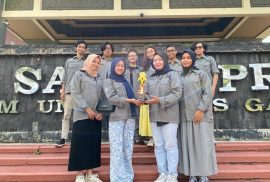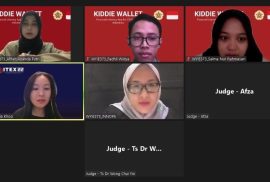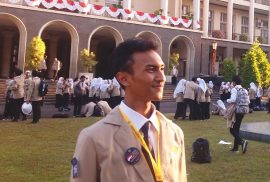
Yogyakarta, January 28th 2021 – The busy ones become quiet, the noisy ones become quiet, the fast ones become so slow. A pandemic may force us to stay at home. But apparently it can’t stop us from working, studying, hoping and doing many other good things. Needs that must be met, problems that must be resolved, time that continues to pass, and a universe that continues to work are unavoidable realities. The same is felt by Ibnu Andy Wicaksana, a student of the Department of Politics and Government who recently won a championship in the Online Distancing Model United Nation Competition (ODMUN) 2.0. He feels that the pandemic period provides lessons about adjustment. This student who is familiarly called Andy said that the pandemic had a lot of influence on MUN, so that activities were transferred online. However, the unpredictable condition of the pandemic has forced Andy to adapt. “Because the substance of MUN is still the same, online or offline is just a platform,” he explained. This student who is also entrusted as President of the UGM MUN Community has just won 3rd place in the ODMUN 2.0. In his statement, the competition was one of the pioneers of online MUN in Indonesia which was also recognized by the Secretary General of the United Nations, Antonio Guterres.With the theme ‘Preserve Liberty, Advance Prosperity’ Andy took a topic that became the main subject of the council’s historical crisis, the Afghan Soviet War in 1980. There was both a burden and an advantage to Andy on this topic. On the one hand, the topics he took on made him the center of discussion. However, on the other hand, it also made him dominant. During the competition process, Andy admitted that he enjoyed it because he could meet many people. “Because it was fun from the start to debate and negotiate, so the award was just a personal bonus for me,” he said.Not only Andy, but Fernando Galang Rahmadana, a final year student at the Department of Sociology of UGM, also managed to close the 2020 perfectly. He won 1st place in the Nature Conservation Jamboree Essay Competition which was held by Bromo Tengger Semeru National Park (TNBTS). Based on the theme, “The Interaction between Humans and the Bromo Tengger Semeru National Park Area”, Nando sent an essay entitled “Young People as Indigenous People of Social Media in the Development of the TNBTS Area”. According to him, the title was a form of simplification of digital native theory which was also conveyed by the committee during the briefing. This is because the organizing committee hopes that the work written by the participants does not need to use complicated language so that it can be understood by the public in general. “The message is kind of a real slap for me as an academic, why should we write in complicated language if there is no meaning for the benefit of society,” Nando said.
Fisipol Today
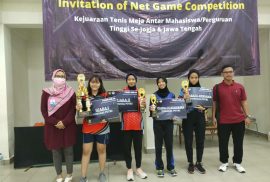
“If we don’t want to enjoy and feel grateful for the process that we’re going through, it’s better if we forget about success completely,” Emma Millania Kartini said. Emma is a batch 2018 student of FISIPOL UGM’s Communication Study who not long ago won the International Table Tennis Championship in Malaysia with her team from UGM. The girl who just turned 20 on 3rd September talks about her long process towards the accomplishment she got. Emma said that since she was in elementary school, his dad has introduced her to table tennis.
The coronavirus pandemic has existed for a long time and it brought a lot of burden to several industries, including Indonesia’s film industry. The pandemic hugely affected the network of cinema who used to be the primary place to watch movies. On 23 March 2020, the local government of DKI Jakarta deactivated one of the biggest cinema companies in Indonesia, Cinema XXI, to support the semi-quarantine measures (Ardanareswari, 2020). At first, only two weeks of deactivation was planned. However, seeing that the situation has not been better, the deactivation is changed to an indefinite amount of time. The local government of DKI Jakarta cancelled the permit to open cinemas numerous times to prevent a more aggressive spread of the virus. In effect, the premier and promotion for several domestic movies are postponed. Several production processes are also halted for an indefinite time.
The spread of the Covid-19 pandemic in Indonesia triggers an array of problems in several sectors. In this case, some activities that used to be done offline have to adapt to an online system. The research sector is also disturbed by this pandemic since several field research can’t be conducted in order to minimize the physical interaction between the researcher and the respondent.
The pandemic and alternative research method
The health and security aspect becomes the utmost priority of each individual, including university students,in the middle of this pandemic. The limitation of space, difficulty to get out of their home, and the strict health rules are factors that contribute to the failure of last year university students to complete their final essay. Generally, this pandemic makes it difficult for final year students to conduct field research or qualitative research that requires them to physically be in the field to observe. Meanwhile, the average research method used by bachelor students, especially in the politics and government department, is the qualitative field research with a primary data source (Savirani, 2020).
Studying abroad is the dream of many students, including Maria Yohanna Widianti Satriyo. This Social Development and Welfare department university student in Fisipol UGM batch 2017 had a chance to exchange to Australia for one semester.
She decided to take a leave from her department for a semester to fly to the kangaroo island in February 2020. In Australia, Maria studied offline for three weeks and online for two months due to the pandemic. The Fisipol Media had a chance to interview Maria through the phone. When this article is released, Maria would have already been in Indonesia, awaiting her study result.
Though the line of events was done virtually, the team expressed their excitement in joining the FGD and other events. “It was very pleasurable because the moderator of the FGD was from a policy study institution and they were like a mentor to us,” said Izul. The same thing was expressed by Brahm. According to him, even though the event is held online, the FGD still expanded their knowledge. “We start to see how the students from other university have a unique perspective on a certain issue,” Brahm elaborated.
Literature is going through rough times. Some might say that it is inching closer towards its doom. Mario Vargas Llosa, a Peruvian literature aficionado, said in its compilation of essay called “The Death of a Great Writer”, that literature in the modern era have lost its magical touch. This is ironic seeing how decades ago, literature was on par with religion; philosophers and literati from all across the world grows rapidly like wild seeds on earth. We know them as the giants of civilization; Sartre, his wife Simone, Zola, Borges, Chekov, Tolstoy, and many more. Meanwhile, now, finding writers on their level is close to impossible.
Since the beginning of the year, fears have been spreading like wildfire. The virus known to originate from an animal and fish market in Hubei Province, China spread and claimed victims all over the world. Novel Coronavirus (later referred to as Corona), the name of the virus, presented itself as a new year surprise and soon became calamity to the world. According to Kompas.com, up until the March 1st, 86.986 cases worldwide have been confirmed, with 2.979 deaths and 42.294 successfully treated. The number might or might not continue to escalate in near future. Whether the numbers rise or not, the fact that worries have haunted not only Wuhan but also other cities in the world should not be called into doubt.
Working in the Ministry of Foreign Affairs is a common dream for students in the Department of International Relations. However, not everyone can have this opportunity. Karina Devira, or better known as Ciput, a student from the Department of International Relations batch of 2017, is one of the lucky few to have this opportunity.
At the beginning, Ciput was still looking for the Indonesian embassy abroad that suits her best. In the end, she chose the Embassy of the Republic of Indonesia in Bangkok. She chose Bangkok due to its proximity to Indonesia and its relatively affordable living cost. As the capital of Thailand, Bangkok also offers an abundance of tourist attractions.
Critical thinking is an important skill that everyone needs, including in the academic world. In addition to critical thinking, the ability to persuade people is also important. One of the ways to practice these two skills is by participating in a Model United Nations (MUN) conference. Aldyth Nelwan, a student from the Department of International Relations batch of 2019, has successfully practiced these two skills in MUN conferences.
Previously, Aldyth was an International Relations student in Universitas Airlangga. His friends suggested him to participate in MUN conferences. Afterwards, he registered himself to participate in an MUN conference due to his curiosity. His friends guided him when he was still new to MUN.