
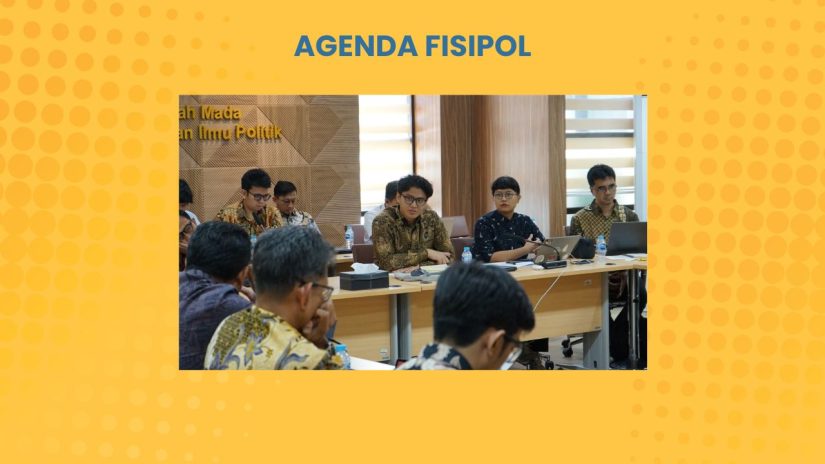
Yogyakarta, June 11, 2026 – The Faculty of Social and Political Sciences at Universitas Gadjah Mada (FISIPOL UGM) hosted a national Focus Group Discussion (FGD) titled “Data and Information Gathering for the Development of the South-South Transition Minerals Learning Cohort Policy Paper” on Thursday (June 11). The event was initiated by Indonesia’s National Economic Council (DEN) in collaboration with the Department of Politics and Government at FISIPOL UGM.
The discussion formed part of a broader effort to develop evidence-based policy recommendations on the governance of Indonesia’s critical minerals, as global demand for strategic mineral resources continues to rise in support of the clean energy transition. Bringing together stakeholders from government, academia, and industry, the forum provided a platform to exchange insights, share experiences, and contribute expertise that will inform the preparation of two strategic policy papers.
The policy discussions centered on two key areas: evaluating Indonesia’s mineral downstreaming policies and strengthening integrated mineral traceability systems, including the Inter-Ministerial Mineral and Coal Information System (SIMBARA). These issues are considered essential for improving transparency in mineral resource management, increasing state revenue, and advancing the implementation of Environmental, Social, and Governance (ESG) principles across Indonesia’s mining sector.
The resulting policy papers are expected to contribute to the South-South Transition Minerals Learning Cohort, a collaborative initiative involving Indonesia, the Democratic Republic of the Congo, Zambia, and Chile. The program aims to facilitate knowledge exchange and promote best practices in critical mineral governance among resource-rich countries that play a strategic role in the global clean energy supply chain.
The discussion was led by the Executive Secretary of Indonesia’s National Economic Council and addressed five strategic themes, including the effectiveness of downstream industrialization incentives, the geopolitical dynamics surrounding critical minerals, strengthening governance and transparency in the mining sector, and the social and environmental impacts of mineral extraction.
The forum brought together a diverse group of participants representing government institutions, academia, and industry. Among those in attendance were representatives from the Ministry of Energy and Mineral Resources, the Ministry of Finance, several State-Owned Enterprises (SOEs), the Government of Central Halmahera Regency, as well as researchers and academics from various institutions.
FISIPOL UGM’s active involvement in this strategic policy dialogue reflects the faculty’s commitment to contributing rigorous academic research and empirical evidence to the formulation of public policy. By fostering collaboration among policymakers, scholars, and industry practitioners, the initiative seeks to promote more sustainable, transparent, and inclusive governance of Indonesia’s mineral resources while addressing the complex challenges of the global energy transition.
The event also reflects FISIPOL UGM’s commitment to advancing the Sustainable Development Goals (SDGs), particularly SDG 7 (Affordable and Clean Energy) through strengthened governance of critical resources supporting the energy transition; SDG 8 (Decent Work and Economic Growth) by encouraging sustainable downstream industrial development; SDG 12 (Responsible Consumption and Production) through improved mineral transparency and traceability systems; SDG 13 (Climate Action) by supporting the global transition toward cleaner energy; and SDG 16 (Peace, Justice and Strong Institutions) through enhanced governance, accountability, and institutional integrity in the mining sector. Through academic excellence and cross-sector collaboration, FISIPOL UGM continues to contribute to the development of evidence-based public policies that support sustainable development both nationally and globally.