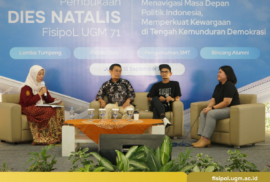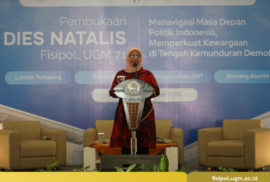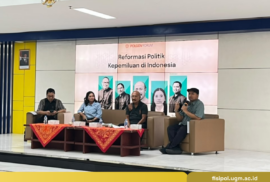
Yogyakarta, August 14, 2026─Entering its eighth decade post-independence, Indonesia is facing a massive wave of changes across various strategic sectors. Responding to these dynamics, the academic community of Universitas Gadjah Mada (UGM), together with several civil society elements, held a discussion titled “Republic Panel: Crisis, Transition, and the Future of the Republic” at the 4th Floor Auditorium of Fisipol UGM on Friday (14/8). This event, held in a hybrid format, is a manifestation of a joint effort between the Department of Sociology Fisipol UGM, Laboratorium Indonesia 2045, Forum 2045, and Nalar Institute.
News
Yogyakarta, August 14, 2026—Amid the increasingly massive onslaught of modern retail development, the local community of Kampung Batik Kauman in Solo continues to strive to preserve their batik businesses. The Gentriset Team from Universitas Gadjah Mada, through the Student Creativity Program in Social and Humanities Research (PKM-RSH), investigated the adaptation strategies employed by local business owners in this area, known as a cultural village.
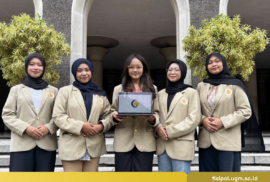
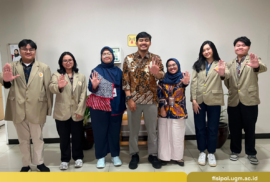
The Gentriset team, through the Student Creativity Program in Social and Humanities Research (PKM-RSH), studied the strategies employed by the local community of Kampung Batik Kauman in Solo to survive amid the rise of modern retail. The team was led by Hanel Aulia Afro (B.A. in Sociology), along with Nasywa Izzati Firdaus (B.A. in Politics and Government), Elang Gading Permana (B.A. in Geographic Information Systems), Laras Dwi Anggraeny (B.A. in Politics and Government), and Nasywa Adinda Ibrahim (B.A. in Cultural Anthropology). They were supervised by Odam A. Artosa, M.A., a Sociology lecturer at the Faculty of Social and Political Sciences (FISIPOL) at UGM.
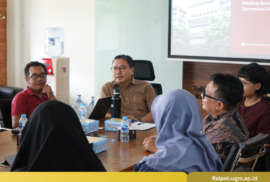
Yogyakarta, August 12, 2026─The Faculty of Social and Political Sciences (FISIPOL) at Universitas Gadjah Mada (UGM) held the next phase of its leadership election through a Public Hearing for the 2026-2031 Dean Candidates. The event served as a platform for candidates to present their ideas and a space to gather aspirations from the entire academic community.
In his opening remarks, the Dean of FISIPOL UGM, Dr. Wawan Mas’udi, reminded everyone of the importance of maintaining harmony amidst the dynamics of the election.
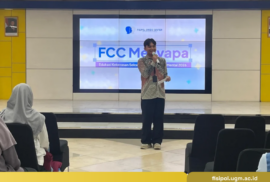
Yogyakarta, August 11, 2026─The Faculty of Social and Political Sciences (FISIPOL), Universitas Gadjah Mada (UGM), has completed organizing the PIONIR Society 2026 series as a welcoming gateway for 629 new students. Carrying the theme “Rangkai Arah Prakarsa Muda” (Formulating the Direction of Youth Initiatives), the faculty successfully introduced a safe and inclusive campus ecosystem that fully supports freedom of expression since the first day of orientation on Wednesday (August 5).
Yogyakarta, July 30, 2026─The welcoming period for new students is always the most anticipated moment at the beginning of every academic year. At the Faculty of Social and Political Sciences (FISIPOL) Universitas Gadjah Mada (UGM), this enthusiasm is burning even brighter as the series of PIONIR Society 2026 events draws near. This event is not only to welcome the new faculty family but also to equip new students as they begin their academic journey at their dream campus.
This year, PIONIR Society 2026 will be held on August 5-6, 2026, as part of the PIONIR Gadjah Mada 2026 series. It carries a profound vision through the theme “Rangkai Arah Prakarsa Muda”. This theme holds a strong philosophical meaning as a gateway to early learning. Through the spirit of togetherness, new students are invited to integrate various ideas and arrange a well-thought-out ‘purpose compass’, so that every step they take always has a clear and directed foundation. Combined with the courage to take initiative, students are expected to become proactive individuals who do not merely absorb knowledge, but are also capable of driving positive changes that have a broad impact on their surroundings.
Yogyakarta, July 24, 2026—The Faculty of Social and Political Sciences (FISIPOL) at Universitas Gadjah Mada held the second day of the 4th Congress of the Indonesian Social Development Association (APSI) on Thursday (July 24) at the 4th Floor Auditorium of FISIPOL. Kicking off the agenda, the main stage featured a keynote speech delivered by the Minister of Environment of the Republic of Indonesia, Mr. Mohammad Jumhur Hidayat.
In his speech, Mr. Jumhur raised the theme “Reviving Environmental Indicators for Social Development: From Ecological Figures to Family Resilience, Justice, and Sustainable Livelihoods”. He drew a common thread that the ecological condition of a region greatly determines the welfare of its community. Social development efforts cannot be separated from environmental conservation, as both are mutually supporting pillars. Ecological damage, he emphasized, will ultimately affect the family as the smallest social unit, and its impacts most severely threaten vulnerable groups such as children, women, the elderly, and persons with disabilities.
Yogyakarta, 20th July 2026—Australia–Indonesia in Conversation (AIC) 2026 at the Faculty of Social and Political Sciences (FISIPOL) at UGM hosted a panel titled “Sustaining Imagination: Eco-Aesthetics, Creativity, and the Ethics of Intelligent Futures.”
Unlike the previous panel, which discussed the governance of power, this panel focused on the perspectives of human creativity, ethics, and ecological sustainability. In his opening remarks, Wawan Mas’udi, Dean of the Faculty of Social and Political Sciences at UGM, emphasized the importance of discussing the influence of AI on human imagination that is both ethical and ecologically conscious. “This panel invites us to reflect on how technological innovation can support—rather than replace—human imagination, while remaining committed to ethical responsibility and ecological awareness,” he said.
Yogyakarta, July 20, 2026—The advent of Artificial Intelligence (AI) can no longer be perceived merely as a technological marvel; rather, it constitutes a complex instrument with the potential to perpetuate domination and structural inequalities. This discourse emerged during the critical deliberations of The 6th Australia-Indonesia in Conversation (AIC) 2026. The inaugural panel, entitled “Governing Intelligence: Ethics, Power, and the Politics of Knowing,” featured Prof. Robert Hassan and Dr. Silvia Montaña-Niño from the University of Melbourne, alongside Prof. Ridi Ferdiana and Pratiwi Utami, Ph.D. from Universitas Gadjah Mada. Moderated by Dr. Indah Surya Wardhani, the session convened at the 4th Floor Auditorium of FISIPOL UGM on Monday (July 20).
Yogyakarta, July 13, 2026─The Faculty of Social and Political Sciences (FISIPOL) at Universitas Gadjah Mada (UGM) once again became a historic gathering point for its alumni. On Saturday (11/7) and Sunday (12/7), the class of 1991 alumni returned to their beloved campus to celebrate the “35th Anniversary Reunion of FISIPOL UGM 91,” carrying the main theme “Reunite, Serve & Share for Our FISIPOL!” (Bersatu Kembali, Mengabdi & Berbagi untuk FISIPOL Kita!).

The series of events on the first day focused on strengthening cultural bonds and camaraderie. Following the registration session, the festivities opened with the “Kirab Bregodo” (Bregodo Parade) in the afternoon. The participants’ use of traditional attire based on the Gagrak Yogyakarta concept served as a symbol of cultural representation deeply ingrained among UGM alumni. The agenda continued with a group photo session and the release of three balloons from each department, creating a memorable visual before participants were directed to a break session.
Yogyakarta, July 9, 2026 – The Faculty of Social and Political Sciences (FISIPOL) of Universitas Gadjah Mada (UGM) is preparing to welcome a new leadership transition for the 2026-2031 period. To ensure a democratic and open process, this year’s FISIPOL Dean Selection Committee prioritizes transparency that directly broadens the space for participation, extending even to the student body.
This selection process is overseen by a committee led by Prof. Dr. Wahyudi Kumorotomo as the Chair and Dr. Dian Arymami, S.I.P., M.Hum. as the Secretary. Overall, this selection team was formed in accordance with the university’s mandate and consists of nine members, comprising three professors and six non-professors.