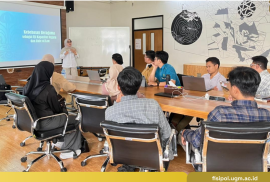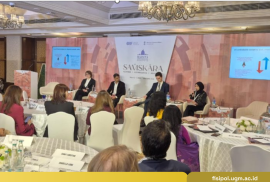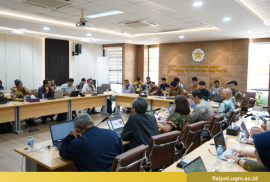
Yogyakarta, June 11, 2026─The Faculty of Social and Political Sciences (FISIPOL) UGM hosted a national-level Focus Group Discussion (FGD) on June 11-12, 2026, with the agenda “Data and Information Gathering for the Preparation of the Policy Paper ‘South-South Transition Minerals Learning Cohort’.” This event was initiated by the National Economic Council of the Republic of Indonesia in collaboration with the Department of Politics and Government, FISIPOL UGM, represented by two department lecturers, Hasrul Hanif and Primi Suharmadhi Putri.
SDGs 17: Partnership for the Goals
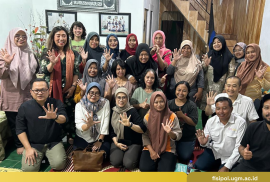
Yogyakarta, 8 June 2026─The Creative Hub of the Faculty of Social and Political Sciences at Universitas Gadjah Mada (FISIPOL UGM), together with partners from the University of New South Wales (UNSW) and the University of Leipzig, conducted an observation and mini-fieldwork study on waste management in RW 05, Terban Village, Gondokusuman, Yogyakarta City.
Indonesia faces challenges in waste management, with a national waste production volume of 23.9 million metric tons per year, 65.45% of which remains poorly managed due to low community participation. The Terban area, located not far from the UGM campus, faces similar issues and was therefore selected as a living laboratory for circular economic transformation through the development of the Gebrak Sampah Ecosystem.
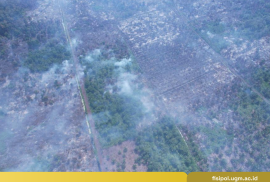
Yogyakarta, June 4, 2026—The Master of Public Policy and Management, Faculty of Social and Political Sciences (FISIPOL), Universitas Gadjah Mada (UGM) organized the Publicness Forum. Held virtually on Thursday (04/06), this public dialogue space carried the theme “Towards Living Space Inclusivity: Rawa Tripa and the Remaining Hope.” This event serves as a critical response to the increasingly alarming ecological and agrarian crisis in Rawa Tripa, one of the most important and historic peat swamp ecosystems in Indonesia.
Yogyakarta, June 4, 2026—The Election Organizers’ Honorary Council (DKPP), in collaboration with the Department of Politics and Government at Gadjah Mada University (DPP UGM), hosted a national seminar to discuss the integrity and ethics of election organizers.
The seminar emphasized that the strengthening of democracy can only be achieved through the integrity of election organizers. The DKPP’s empirical experiences were shared as key insights for building a stronger democratic framework in Indonesia. The discussion focused on how integrity in election management is crucial for public trust and the overall health of the democratic process.
Yogyakarta, June 2, 2026—The Doctoral Program in Political Science at Universitas Gadjah Mada (UGM) hosted a public lecture to discuss the book Understanding Jokowi: Progressive Realism in Indonesian Politics (2014–2024). The event marked the start of a two-day colloquium for doctoral students in Political Science at UGM.
The public lecture was attended by undergraduate, master’s, and doctoral students from UGM’s Department of Political Science. Amid the dominance of political researchers from Australia and the United States in Indonesia, this event offered a new perspective on Indonesian politics from a French academic tradition.
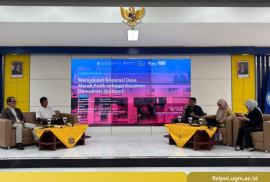
Yogyakarta, 20th May 2026—The Social Research Center at Gadjah Mada University, in collaboration with the Caksana Institute, held a public discussion to address issues with the Merah Putih Village Cooperative (KDMP) policy that threaten economic democracy.
Dr. Andreas Budi Widyanta, one of the speakers, emphasized that the current concept of KDMP has strayed far from the original ideals of Mohammad Hatta’s cooperative concept. “Cooperatives were born out of a shared need among their members, which were then managed democratically without the employer-employee divide. In contrast, KDMP is a tangible manifestation of state corporatism,” he asserted.
Yogyakarta, May 19, 2026─DEMA FISIPOL UGM’s Selasar Forum highlighted the vulnerabilities faced by migrant domestic workers on Tuesday at the FISIPOL UGM Selasar Barat.
In commemoration of Labor Day (May 1), the Student Council (DEMA) of the Faculty of Social and Political Sciences at Gadjah Mada University held a Forum Selasar with a primary focus on highlighting the vulnerabilities experienced by Indonesian migrant domestic workers. The event took place at the West Selasar, FISIPOL UGM, and featured several speakers from Beranda Migran and the Coordination of Former Indonesian Migrant Workers (KOPPMI).
Yogyakarta, May 8, 2026─The Department of Politics and Government (DPP) of the Faculty of Social and Political Sciences (FISIPOL) UGM reaffirms its commitment to advocating for democracy and human rights issues. Through the Master’s Program in Political Science, DPP FISIPOL UGM organized a guest lecture titled “Religious Freedom as a Test of State Capacity and the Rule of Law” on Friday (8/5). The event, held at the Big Data Lab, featured Dr. Hurriyah, an academic from the Department of Political Science, Faculty of Social and Political Sciences (FISIP) Universitas Indonesia (UI), as the guest lecturer.
Yogyakarta, May 7, 2026─In an effort to respond to the increasingly challenging dynamics of national politics, the Politics and Government Student Corps (KOMAP), Faculty of Social and Political Sciences (FISIPOL) Universitas Gadjah Mada, in collaboration with the Association for Elections and Democracy (Perludem), successfully organized an interactive talkshow. Presenting the main theme “From Campus for Democracy: Safeguarding Election Reform Through the Revision of the Election Law,” the event took place solemnly and enthusiastically on Thursday (7/5) in the open area of the West Corridor (Selasar Barat), FISIPOL UGM.
Yogyakarta, May 7, 2026─Ernani Dewi Kusumawati, a doctoral student in International Relations at FISIPOL UGM, has achieved a new milestone on the global stage. Joining the Department of International Relations in 2024 as a doctoral student with a concentration in Digital Transformation and Competitiveness (DTC) led her to become Indonesia’s one and only delegate at the Raisina IE-Global Student Challenge 2026, held in New Delhi, India, in March 2026.
This competition is part of the Raisina Dialogue international forum, a strategic gathering that brings together world leaders, government officials, academics, and practitioners to analyze geopolitical and geoeconomic issues. Ernani shared that she initially had doubts because her undergraduate background was in pharmacy. Nevertheless, those doubts transformed into a strong motivation as she delved into the essence of the event. She views an interdisciplinary approach as the key.