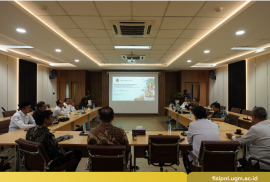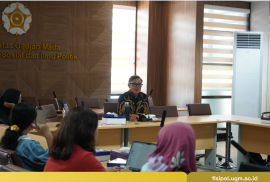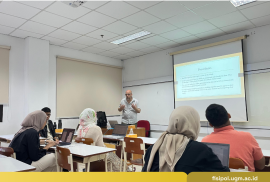
Yogyakarta, April 24, 2026─The Research Center for Politics and Government (POLGOV) Universitas Gadjah Mada (UGM), in collaboration with PUSAD Paramadina, publisher Marjin Kiri, and the Kurawal Foundation, organized a discussion forum and literature release entitled “The Resurgence of Authoritarianism in Indonesia: A Decade of Jokowi’s Leadership” (Kebangkitan Kembali Otoritarianisme di Indonesia: Dasawarsa Kepemimpinan Jokowi). This political book review agenda was held on Friday (24/4) afternoon in the West Corridor (Selasar Barat) area of FISIPOL UGM.
SDGs 17: Partnership for the Goals
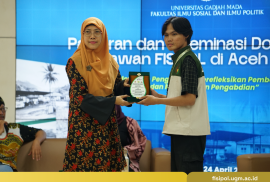
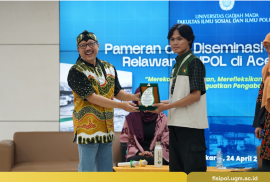
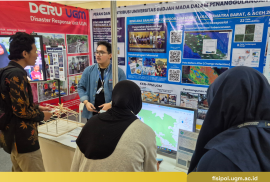
Yogyakarta, April 24, 2026─The Faculty of Social and Political Sciences (FISIPOL) of Universitas Gadjah Mada (UGM) reaffirmed its tridarma (three pillars of higher education) commitment by organizing the “Dissemination of FISIPOL Volunteer Documentation in Aceh and IKN”. Held on Friday (24/4) at the 4th Floor Auditorium of FISIPOL UGM, this forum was designed as a space to share experiences and findings during the community service and research periods of students who plunged directly into responding to environmental crisis issues in the community.
Yogyakarta, April 23, 2026—The Department of Sociology, Faculty of Social and Political Sciences (FISIPOL) Universitas Gadjah Mada (UGM) organized a data analysis workshop entitled “Thematic Analysis and its Use in the Study of Pentecostal Representations of God.” This academic activity was held in Room BG 203 on Thursday (23/4), from 10:00 to 11:30 WIB.
This workshop served as the closing event for the visiting scholar program series of Professor Martin Lindhardt from the University of Southern Denmark. Previously, Prof. Martin had led two main agendas at UGM, namely a sharing session entitled “Digital Sociology: Recent Developments in the Sociological Study of Relations between Digital Technologies and Social Life” on Monday (20/4) and a public lecture on “The Economics of Pentecostal/Charismatic Christianity” on Wednesday (22/4).
Yogyakarta, April 23, 2026─Mental health issues among university students are increasingly gaining serious attention from various parties. Responding to this urgency and as a concrete step toward creating a safe learning space, the Fisipol Crisis Center (FCC) UGM, in collaboration with the Center for Public Mental Health (CPMH) of the Faculty of Psychology UGM, successfully held a Psychological First Aid (PFA) Training.
The activity, which aimed to equip the academic community to prepare themselves for mental health crises, took place on Thursday (23/4) from 08:00 to 15:00 WIB in Room BG 203, Faculty of Social and Political Sciences (FISIPOL) UGM. This event specifically targeted students actively involved in various Student Activity Units (UKM) within FISIPOL, and was also open to the general public interested in mental health issues.
Yogyakarta, April 23, 2026 — The Department of Sociology, Faculty of Social and Political Sciences, Universitas Gadjah Mada (FISIPOL), held a data analysis workshop entitled “Thematic Analysis and Its Use in the Study of Pentecostal Representations of God” in Room BA 204 on Thursday (April 23) from 10:00 to 11:30 a.m. Western Indonesian Time.
This workshop marked the final event of the visiting scholar program by Professor Martin Lindhardt (University of Southern Denmark) at FISIPOL UGM. Previously, he had presented two sessions: a sharing session on “Digital Sociology: Recent Developments in the Sociological Study of Relations between Digital Technologies and Social Life” and a public lecture on “The Economics of Pentecostal/Charismatic Christianity.”
Yogyakarta, April 23, 2026 – The Faculty of Social and Political Sciences Crisis Center (FCC), in collaboration with the Center for Public Mental Health (CPMH) of the Faculty of Psychology, UGM, held a Psychological First Aid (PFA) Training in Room BG 203, FISIPOL UGM, on Thursday (April 23). Held from 8:00 a.m. to 3:00 p.m. Western Indonesian Time (WIB), the event specifically invited students from FISIPOL student organizations (UKM) and the general public.
This training is not the first of its kind. “The FCC conducted this training three years ago for students, but now that they have graduated or are about to graduate, we are updating it,” said Arie, a representative of the FCC, in his remarks. This demonstrates the FCC’s commitment to creating an inclusive environment.
Yogyakarta, April 22, 2026—The Department of Sociology, Faculty of Social and Political Sciences, Universitas Gadjah Mada (FISIPOL UGM), highlighted the relationship between religion and economics in a public lecture on Wednesday (April 22).
Featuring Prof. Martin Lindhardt from the University of Southern Denmark as the keynote speaker, the public lecture, titled “The Economics of Pentecostal/Charismatic Christianity,” sought to understand the relationship between religion and economics, which is becoming increasingly important in Indonesia. Furthermore, religious activities play a significant role in the social and economic life of society.
Yogyakarta, April 22, 2026—The Department of Sociology, Faculty of Social and Political Sciences, Universitas Gadjah Mada (FISIPOL UGM), highlighted the relationship between religion and economics in a public lecture today.
The public lecture featured Prof. Martin Lindhardt from the University of Southern Denmark as the keynote speaker. The event was open to the public and was attended by undergraduate and graduate students of the Sociology of Religion course.
Understanding the relationship between religion and economics is becoming increasingly important in Indonesia, where religious activities play a significant role in the social and economic life of society. UGM presented a public lecture titled “The Economics of Pentecostal/Charismatic Christianity” with international expert Professor Martin Lindhardt. This public lecture provided an opportunity for the academic community to broaden their understanding of the dynamics of religious economics, which are highly relevant to Indonesia’s current socio-economic conditions.
Yogyakarta, April 21, 2026—The Chairman of the Regional Representative Council of the Republic of Indonesia (DPD RI), Dr. (H.C.) Sultan Baktiar Najamudin, emphasized the strategic role of universities in realizing green democracy in Indonesia.
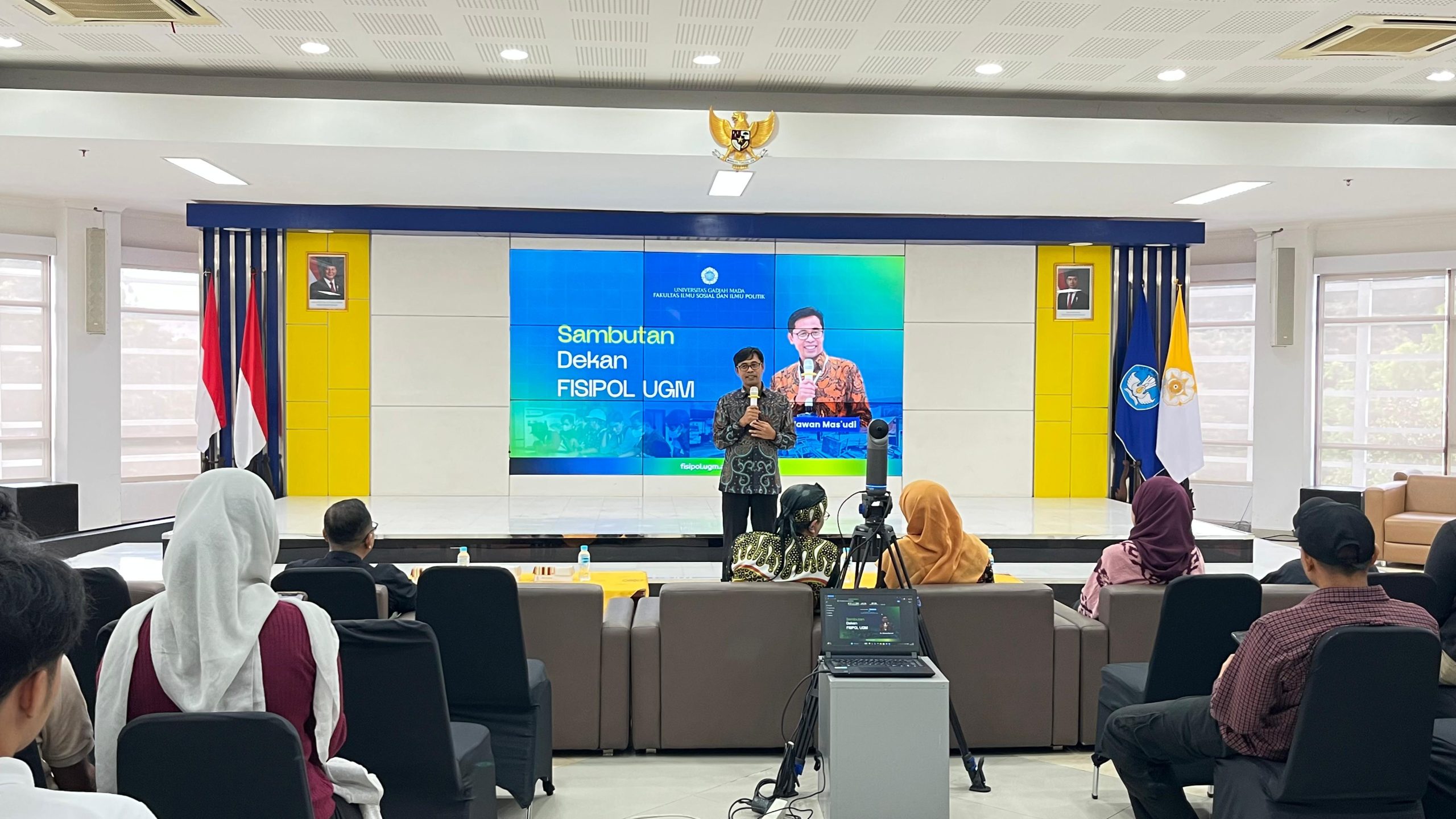
In his opening remarks, the Dean of FISIPOL UGM, Wawan Mas’udi, emphasized the importance of discussing green democracy amid the current challenges posed by climate change. “With climate change, we are facing the challenge of creating a governance system that is aware of global changes that increasingly require green politics, green policies, and in this case, green democracy,” he said.
Yogyakarta, April 21, 2026—The Chairman of the Regional Representative Council of the Republic of Indonesia (DPD RI), Dr. (H.C.) Sultan Baktiar Najamudin, emphasized the strategic role of universities in realizing green democracy in Indonesia.
In a public lecture at the FISIPOL UGM Auditorium, Najamudin emphasized that the Green Democracy ideas he championed have been systematically outlined in a book entitled “Green Democracy: Ideas for Democratic Innovation in Strengthening the DPD RI Institution, Environmental Conservation, and Improving Human Resources Quality Towards a Golden Indonesia 2045.” According to Najamudin, universities are not merely spectators or critics of policies, but rather the primary drivers of democratic transformation toward an ecologically sustainable system.